Sunday, June 28, 2015

The Caltech Brass Quintet

I have played in a LOT of brass quintets. If you haven't, I highly recommend it. The Caltech (California Institute of Technology) Brass Quintet was chronologically one of my first and enjoyably, one of the best.

The Caltech Brass Quintet, c. 1983 (L-R): Bill Bing, trumpet and coach;
David Hodge, horn; Mark Cohen, tuba;
Greg Ojakangas, trombone (blocked from view); Ray Burkhart, trumpet.

No, I wasn't a student at Caltech, but I do have links there. My uncle Noel went to Caltech in the 1940s and was captain of their football team. An athlete-scholar. My brother Reed attended Caltech while I was a short distance away, attending Occidental College. He sang in the Men's Glee Club, played sax in the jazz band, and was an All American water polo goalie. A musician-athlete-scholar. And a dear family friend, sort of my "adopted" grandmother, attended Throop College of Technology, just before it became Caltech in 1920.

While not a Caltech student, I still made a lot of music there. Bill Bing was my trumpet teacher at Occidental and a good friend. He and his wife, Delores, are Artists-in-Residence and Co-Directors of Instrumental Music at Caltech, and Bill saw to it that I got lots of valuable musical experience, to help me prepare for a career in music. If some of that experience was gained playing in his Caltech concert band, jazz band, and brass quintet, so much the better. I can certainly attest to the enhanced learning benefits of playing chamber music with one's teacher!

Not long after I graduated from Oxy, I sometimes subbed for Bill at Caltech, leading rehearsals of the concert band and jazz bands. I composed and arranged for the Caltech Concert Band, as well. When someone discovered a piano score to E. C. Kammermeyer's "Throop Institute March," Bill had me score it for band. They've played it often, including at their Carnegie Hall concert in 2008. Hear some of it in this CBS news story (second bit of music, around 1:40). I also arranged a medley of Caltech songs from the 1920s for their band. The five songs plus alma mater have the 1920s corny sentimentality you might expect, and given that in those days the Los Angeles area was undergoing almost nightly spraying of malathion to eradicate a crop-endangering insect infestation, my arrangement became (almost) lovingly known as the Caltech Medfly. You could play it and put it away, but every few years, it'd come back. Bill also commissioned my first composition for band, Exordium. I guess I thought a Latin title would kick it up a notch. Check out Caltech Bands here, and you can listen to the Throop Institute March and the Caltech Medley, as recorded on the Caltech Band CD, "TECHnically Sound," here.

But the fact is, I don't recall actually playing much in the Caltech Brass Quintet. Yes, we met to rehearse every week, and we performed plenty, but we spent most of our time laughing. Bill Bing is a natural comic, as anyone knows who has attended one of his nearly 40 years of giving Caltech instrumental concerts, and he invariably brought to our invariably-late-night rehearsals his orange dog, "Mousse." I always thought it was "Moose," which was already pretty funny for such a small dog, but I can see now that Mousse might have acquired his name from the, uh, odd way his hair, such as he had, stuck out from his body, like it was dressed up with mousse. But, as Shakespeare surely would have avoided saying, Mousse/Moose by any other name would be just as orange.

We all loved Mousse, but he was either the source of, or the object of, a great deal of humor. That was mainly thanks to the rest of the members of the group. Hornist David Hodge worked at Caltech, building specialized research equipment. Tubist Mark Cohen was a doctoral student in Chemistry. Trombonist Greg Ojakangas was a doctoral student in Astrophysics; also a gifted jazz musician. And the three of them just wouldn't let up on the jokes. If guys in unguarded moments display the social development of a seventh-grader, then these guys were at the top of the class. I think Bill always had a musical goal in mind, a grand purpose for each rehearsal, but we rarely bore down too hard on details. We couldn't. We were just having too much fun keeping each other in giggles and stitches. Even as we'd take the stage to perform, I'd be in tears of laughter.

For the trumpet geeks -- and please correct me, Bill, if I'm wrong -- the trumpet Bill has in the above picture is his Conn 22B, which had previously belonged to Harry Glantz.

I've lost touch with Marc and Greg and David. Maybe through the mysteries of the cyberweb one or more will get in touch. That'd be nice. I don't see Bill enough, and while we've long been friends, he probably doesn't know just to what an extent he was a positive and important influence on me, at a time when I needed it. Thanks, Bill. You've mentored many young musicians into better lives of music and humanity, especially at Caltech!

Dr. Ray

Saturday, May 9, 2015

Published: "Two Roman Motets" for brass quintet

My new arrangement for brass quintet, "Two Roman Motets," is now published by Premiere Press. You can view a performance of one of the motets here.


The brothers Fabio and Alessandro Costantini, long thought to have been born in the small Italian town of Staffolo, were prominent church composers in 17th-century Rome. After my thrilling week in Staffolo  playing, conducting, and teaching as part of Staffolo's 20th annual Music Festival in June 2014  I decided to honor Staffolo and my many new friends there by arranging and publishing an arrangement for brass quintet of two 17th-century motets, one by Fabio Costantini and one by Alessandro Costantini. The publication is dedicated to the conductor of the Staffolo Town Band, Maestro Samuele Faini. Each motet lasts about 2.5 minutes.

Elsewhere in this blog, you can read my posts about my 2014 Italian adventure, more about how I came to write Two Roman Motets and my new composition Ricordi d'Italia, and all about their world premieres in January 2015.

Enjoy!
Dr. Ray

Published: "Ricordi d'Italia" for brass quintet

Ricordi d'Italia (Memories of Italy), my new composition for brass quintet, is now published by Premiere Press. You can view excerpts of its world premiere on YouTube here.

New logo by Emilie Pallos Graphic Design

The four movements of Ricordi d'Italia are based on experiences I enjoyed in Italy during the summer of 2014. The first movement (Staffolo Fanfare) is a flashy opening that honors the small hilltop town where I spent one of the best weeks of my life. The second movement (The Ancient Wall) ponders the mysteries of the many Roman walls that surround towns like Staffolo. The third movement (Bella Valentina) is a joyous waltz with optional sing-along, sort of a valentine from me to the lovely women of Italy. The fourth movement (Canzon San Marco) honors the music of the great Venetian composer, Giovanni Gabrieli, and Basilica San Marco, where his timeless antiphonal music was played. The overall duration is about 11'30".

Elsewhere in this blog I have written about my 2014 Italian adventure, how Ricordi d'Italia came to be composed, and of its world premiere.

Ciao!
Dr. Ray

Tuesday, March 3, 2015

Premiered: Ricordi d'Italia and Two Roman Motets

In my last post, I described the then-upcoming "Sounds of Italy" concert in Palo Alto, California, given by the Amici Americani and Oxford Street brass quintets.

The Amici Americani brass quintet in Palo Alto. L to R:
Tyler Morse, John Monroe, Mark Lindenbaum, Ray Burkhart, and Tom Hyde

The program was Italy-related, and some of my brass quintet works were performed, including my popular three-movement suite, Italian Postcards, my palindromic fanfare, Toot, and the world premieres of my original four-movement suite, Ricordi d'Italia, and my arrangements of two 17th-century Roman choral works by the Costantini brothers, Fabio and Alessandro, entitled Two Roman MotetsMy arrangement of Giovanni Gabrieli's Canzon Septimi Toni No. 2 for large brass ensemble was also performed, by joining the Amici Americani with the Oxford Street Brass.

Ricordi d'Italia logo by Emilie Pallos Graphic Design,
featuring the historic portal to Staffolo, Italy.

Ricordi d'Italia fulfilled a commission to compose a piece for brass quintet based on my experiences in Italy during the summer of 2014. It's a great story with lots of photos. Read more here.

Click here for a YouTube video montage of excerpts from each of the four movements of Ricordi d'Italia. The audience sing-along in the third movement, Bella Valentina, is optional, but loads of fun!

Publication forthcoming soon!

I arranged Two Roman Motets in honor of my many new friends in the lovely small town of Staffolo, Italy, especially those in the town band. It is dedicated to the band's director, Maestro Samuele Faini. 

Brothers Fabio and Alessandro Costantini, whose lifetimes extended from the late 16th century well into the 17th century, were long thought to have been born in Staffolo, and while recent research suggests otherwise, they are still revered there. Both Costantinis held church music positions in Rome and elsewhere, playing organ and composing choral music. 

Click here for a YouTube video of the Amici Americani playing the first of the Two Roman Motets, "O Admirabile Commercium!" by Fabio Costantini.


Ricordi d'Italia, Two Roman Motets, and my arrangement of Giovanni Gabrieli's Canzon Septimi Toni No. 2 for brass ensemble (eight or ten brass) will be published soon and available for purchase from my online store. See RaymondBurkhart.com.

The Amici Americani brass quintet rehearses for the January 2015 Sounds of Italy concert:
L to R, Ray Burkhart, John Monroe, Mark Lindenbaum, Tyler Morse, and Tom Hyde.

Chamber music is often called 'the music of friends', and so it was with the commission of Ricordi d'Italia, the arranging of Two Roman Motets, and the Sounds of Italy concert. Friendship was key. My Amici friends, Mark Lindenbaum and John Monroe, together with their better halves, Margaret Jahn and Meg Monroe, commissioned Ricordi d'Italia. I arranged Two Roman Motets to honor our friends in Italy. And many friends and family attended the Sounds of Italy concert. It was a great pleasure to see them there. One friend flew in from as far away as Arkansas!

Friends in the audience also generously supported our charitable goals. The Oxford Street Brass raised funds for the Mr. Holland's Opus Foundation, and the Amici raised funds to assist in the bringing of a student musician from Italy to attend the 2015 Humboldt State University Brass Chamber Music Workshop in Arcata, California. The Amici and the Oxford Streeters are very grateful for this support.

Brass chamber music may be more popular in the world today than ever before. The Amici Americani relish that tradition and hope to promote brass chamber music on both sides of the Atlantic. Friends joined together in a worthy goal may accomplish great things!

Ever your friend,

Dr. Ray

Saturday, January 3, 2015

World Premiere: Ricordi d’Italia

Ah, I remember it well. Italy, that is. The good weather, the better food, the best gelato. Making music, making friends, and now, making memories  literally. Memories of Italy. Ricordi d'Italia.

I already blogged about my summer 2014 trip to Italy. You can read it, and see some fun photos, HERE. Part of that experience included a commission to compose music for brass quintet, based on my experiences in Italy. I recently finished that work, Ricordi dItalia (Memories of Italy). The world premiere is to be given at 8pm, Saturday, January 10, 2015 on the Sounds of Italy concert at All Saints Episcopal Church, 555 Waverley St., Palo Alto, CA. 

I hope you will attend and tell your friends!


Two brass quintets will perform: the Amici Americani degli Ottoni  the quintet that went to Italy last summer  and the Oxford Street Brass, a quintet from the San Francisco Bay area. Each quintet will give about half of the program, and the combined quintets will perform two pieces for large brass ensemble  a transcription of Giovanni Palestrinas Jubilate Deo and my arrangement of Giovanni Gabrielis Canzon Septimi Toni No. 2. The Amici will premiere my Ricordi dItalia, and the Oxford Street Brass will perform my earlier work, Italian Postcards (see blog). It’ll be great to have both works on the same program, along with music by Antonio Vivaldi, Gioachino Rossini, José Carli, Luigi Zaninelli, the Costantini brothers, and Zack Smith.

The concert is free. A free-will offering will be taken to support causes supported by the two ensembles.

I’m truly grateful for the ways in which the rest of the Amici – Tom Hyde, Tyler Morse, John Monroe, and Mark Lindenbaum – and the Oxford Street Brass – Rob Lenicheck, Ken Walter, Cathleen Torres, Greg Bergantz, and Bob Lipton – are participating in and supporting the Sounds of Italy concert.

New logo by Emilie Pallos Graphic Design

Ricordi dItalia was commissioned by Mark Lindenbaum, Margaret Jahn, and John and Meg Monroe. Thank you!

Here are some other notes about Ricordi dItalia.

The first movement, Staffolo Fanfare, is based on the rhythm of the phrase, “I love Staffolo!” And indeed, I do.

In the slow second movement, The Ancient Wall, I hope to evoke the venerable mystery suggested by the ancient walls that still surround old sections of many Italian hilltop towns. To me, these medieval walls stand as silent witnesses to centuries of events, both great and small, momentous and ordinary. The theme is derived from the group warm-ups the Amici enjoyed each morning, as we sat on one of the porches at Mark’s home just outside Staffolo, taking in the gorgeous views and exhaling the sweet farmland air through our instruments.

The third movement, Bella Valentina, is more fanciful than autobiographical. I did meet a lovely young college student named Valentina in a gelato shop (Gelateria Riva) during a sudden rainstorm one afternoon in the charming little town of Varenna on Lake Como, and while we enjoyed a good chat, a legendary romance was not in the making. I was, however, immediately struck by the melodiousness of her name, and I suspected it would figure in some way in my new composition. When it came time to write a love song movement, I rejected the idea of slow music – I had already composed The Ancient Wall – in favor of something joyful and rousing. I recalled how, at some of the dinners that the Amici Americani enjoyed with the Staffolo City Band, that a guest band would not commence to eat until they had sung a particular, very jolly song. So, I crafted Bella Valentina as a seemingly old folk song, overlayed with increasingly complex contrapuntal lines – sort of a musical lasagna. There is even an optional vocal section in which the audience may sing along.

The fourth movement, Canzon San Marco, is my homage to the great polychoral music popular in Venice at Basilica San Marco around the year 1600, especially the music of Giovanni Gabrieli. This repertoire – whose original popularity was widely influential, but relatively brief – is still engaging and much enjoyed today, especially by many brass players. I deeply treasure the experience of visiting St. Mark’s, observing its remarkable design, and imagining Gabrieli’s music sounding throughout the space. Treading the same floors and stairwells used by Gabrieli and his musicians over four centuries ago had special meaning for me. The movement opens, Gabrieli-like, with imitative counterpoint. I formed my theme by combining melodies from the first and penultimate measures of Gabrieli’s Canzon Septimi Toni, No. 2 (from Sacrae Symphoniae, 1597). The successive entrances of my five voices, however, outline a major 9 chord, which, along with other departures from Gabrieli’s style, modernize the late-Renaissance Venetian sound. This leads to a cadence that sets off a jazz-rock waltz, complete with solos for horn and trombone. The movement closes with another Gabrieli-ish section, and musicians familiar with Gabrieli’s style will note many places where I employ or imitate nuances of his composition and orchestration.

I’ll report back after the concert. I hope to see you there!

Ciao!

Dr. Ray

Friday, December 19, 2014

The Time for Auld Lang Syne is Now!

The turn of a new year is celebrated in most cultures. It gives one pause to reflect on the past, to consider the future, and celebrate the present. It is widely traditional to sing Auld Lang Syne  the historic words of Robbie Burns set to an old Scottish folk song  at midnight on New Years Eve and at other occasions when things of the past are brought to mind.

I have always loved Auld Lang Syne, and this post tells how I came to arrange it for many kinds of ensembles (choral and instrumental), and more importantly, how you can get your own copy to sing or play at New Years, retirements, parties, and even chamber music readings. Let this modern setting be not forgot!


My arrangement of Auld Lang Syne of approximately four minutes in length (can be shortened to one or two verses, if desired) is available for purchase right now for:

In time, I might make more versions available. If you have a specific interest, write me to inquire: ray@raymondburkhart.com. The choral version is priced per copy. Instrumental versions are $14 plus tax and shipping.

To Listen

To hear a recording of my Auld Lang Syne, go HERE, find Auld Lang Syne at the bottom of the page, then click on mp3 or recording. I thank tubist David Holben for making and offering this recording.

Also, the venerable Hill St. Sax Quartet recently played the sax quartet version streetside and "live" in Montrose, CA. Watch the video!


How to Order

These versions are available now, even before my website can be updated. Some versions can be ordered there (SATB choral, brass quartet, trombone quartet, and tuba quartet), but for the others, email me for details, which basically are these: you can send the funds by Paypal, and Ill send out the order ASAP. But, please email me first to get the correct amount (including shipping, and tax, if relevant).

Backstory

In 1987, I wrote a bold, flashy version of Auld Lang Syne for my friend Kevin Brown and his Tournament of Roses Herald Trumpeters to play for the Rose Parade. When I joined the Disneyland Fanfare Trumpeters, they added that version to their repertoire. Then it came to me to write against type and give the Disneyland Fanfare Trumpeters a quiet version to play as well. I used jazz harmonies, and it was a hit. These two contrasting versions have been in print for many years as Two Settings of Auld Lang Syne – one publication for four trumpets and one publication for brass quintet.

Some years later, my friend, the eminent choral conductor, Dr. Thomas Somerville, retired from his long-time position as Director of Music at First Congregational Church of Los Angeles, and his choir commissioned a setting of Auld Lang Syne to sing for him. I crafted a four-verse setting based on the jazzy version I had already done, and it was a success, too (see my catalog, #1036).

Old Times, New Times

This year, John Skelton, who each year in Salem, Oregon conducts one of the many popular mass-tuba Christmas concerts, heard a performance of my trumpet ensemble version of Auld Lang Syne on Youtube, and he asked if I would make a version of it for his tuba event. Instead of adapting the trumpet version for him, I adapted my choral version, to provide more length and variety. It then hit me how this music could be adapted for many instrumental ensembles.

So, think of how you might enjoy this music. If you are in one of the kinds of ensembles listed above, you might use Auld Lang Syne at New Years time, either for a gig or just to sing or play with friends. You might use it for parties during the year  birthdays, retirements, or other special occasions. You might give it as a gift to friends and relatives who play chamber music, or you might want it for your choir to enjoy. Whatever your interest, be sure to consider adding my Auld Lang Syne to your library or giving it as a gift. Either way, new times are always coming when itll be good to celebrate the old times, and Auld Lang Syne will be just the thing you need!

Happy New Year!

Dr. Ray

Monday, July 21, 2014

I’m In Italy!

Actually, Im back home now, but I was in Italy for most of June and the early part of July 2014, and it was great. This is that story.


Why
I went to Italy this summer to participate in the 20th Annual Music Festival offered by the Banda Musicale Città di Staffolo (Staffolo City Band). The festival concerts were given in Staffolo’s ancient piazza on June 28 and 29. For two videos from one of our concerts, and videos from other parts of the festival, go HERE.

My friends, Mark Lindenbaum and Margaret Jahn of Bellingham, Washington, recently renovated a farm house [see LUliveto Staffolano] near Staffolo that is available to rent for self-catering vacations and which they visit once or twice per year. Given tubist Mark’s love for brass chamber music and his enjoyment of Staffolo, it was only a matter of time before he invited fellow brass players to Staffolo to play chamber music.

L'Uliveto Staffolano: self-catering apartments just outside Staffolo, Italy.

But, Mark had larger plans. In recent years he has made friends in the Staffolo City Band. Working with civic and band leaders, a plan was formed to enlarge Staffolo’s annual band music festival to include brass chamber music played by a brass quintet assembled by Mark for the occasion.

Thus, the Amici Americani degli Ottone (American Friends of Brass) came to be. A large brass and percussion ensemble comprised of Amici and Staffolo band brass players was organized. The Amici Americani also performed in concerto grosso fashion with the Staffolo band, and the Staffolo band performed one of my compositions. The Amici and the large brass ensemble also performed some of my works.

Rehearsing the large combined brass ensemble.

Other musical and civic events were scheduled for the festival weekend, including a concert by the Orchestra di Fiati (Wind Orchestra) della Provincia di Vicenza with their featured soloist, Italian tuba virtuoso Alessandro Fossi. The Amici Americani joined Fossi to perform the Concertino da camera for solo tuba and brass quintet by Swedish composer Christer Danielsson (1942-1989).

The Amici Americani with tuba soloist Alessandro Fossi.

Festival performances were also given by the Banda di Torrette e di Ostra and the Orchestra di Fiati del Liceo Rosmini di Rovereto.


It was a pleasure and an honor to rehearse and perform with the Amici Americani and Alessandro Fossi and to conduct the large brass ensemble and the Staffolo band.


Where
Staffolo is a small town about thirty minutes west of the Adriatic port city of Ancona in the eastern central region of Italy known as Le Marche. [Wikipedia] [Images] Staffolo is considered one of the Best Small Towns in Italy. This video shows many images of the town where I spent one of the best weeks in my life. If you haven’t visited there, I highly recommend it!

One of the entrances to the walled city center of Staffolo.

Staffolo’s new Mayor, Patrizia Rosini, welcomed the Amici and the guest bands warmly and enthusiastically. She also presided over a formal ceremony recognizing the various participants in the music festival, where she presented me with a book containing important historical Staffolo documents, for which I am most grateful. Patrizia used to play tenor saxophone, so I think the Staffolo City Band has a bright future!

Ray and Staffolo Mayor Patrizia Rosini.

Who
Amici Americani degli Ottone 

Amici Americani di Ottone in Gubbio, Italy (L to R):
John Monroe, Ray Burkhart, Tyler Morse, Mark Lindenbaum, and Tom Hyde.

Mark Lindenbaum formed the Amici Americani degli Ottone (American Friends of Brass) from friends made at the Humboldt State University Brass Chamber Music Workshop. The players include trumpeters Tom Hyde of Graton, California and me; hornist Tyler Morse of Brisbane, California; trombonist John Monroe of Stanford, California; and Mark on tuba.

Amici Americani in concert in Staffolos piazza, June 28, 2014.

We spent a wonderful week in Staffolo preparing for the two concerts, but one cannot play a brass instrument all day, so the Amici visited nearby sights. At a local Staffolo festival, we heard local musicians, saw costumed children present regional dances, tasted local seafood and olive specialties, and met our first new Staffolo friends. Ciao, Anno! The nearby town of Cupramontana and its morning market supplied tasty cheeses, meats, and vegetables. Half-day trips to the Frasassi caves and the ancient hill town of Gubbio, with its Roman amphitheater, provided geographical and cultural delights. I introduced Tom to granite  Italy's yummy fruit slushes  and we all sought to find the best gelato.

Tom Hyde and I cool it in Cupramontana.

The Staffolo City Band


The Banda Musicale Città di Staffolo in a proper pose.

The Staffolo City Band is made up of talented and fun musicians from the Staffolo area and nearby towns. Community bands figure importantly in Italian culture, and the Staffolo City Band appears in concerts and parades in Staffolo and surrounding communities and also travels to perform. Players in the band range from boys and girls in grade school to retired folks, with everything in between! Daily rehearsals with the Staffolo band and its brass players were a highlight of the week. 

Some of the band, as I came to know them. Theyre not as blurry in real life.

The Music
The Saturday night concert began with the large brass and percussion ensemble, followed by the Amici Americani brass quintet’s program and the band’s two pieces. Here’s the program (all of my compositions are in print and available for purchase--see links below):

Combined Brass and Percussion
Raymond Burkhart, Conductor

Aaron Copland, Fanfare for the Common Man
Chris Hazell, Kraken 
Hazell, Mr. Jums
Jimmy McHugh (arr. John Iveson), On the Sunny Side of the Street
Raymond Burkhart, Rejoice!

(Kraken was encored.)

Amici Americani degli Ottone
Victor Ewald, Brass Quintet No. 1
Luigi Zaninelli, Designs
Kevin McKee, Escape
John Cheetham, Scherzo

Staffolo City Band
Raymond Burkhart, Conductor

Rayburn Wright, Shaker Suite for Brass Quintet and Band
Samuele Faini, Conductor

(Sophies Waltz was encored.)

The Sunday night concert featured a daring and highly polished program by the Orchestra di Fiati (Wind Orchestra) della Provincia di Vicenza. In addition, the Concertino da Camera for solo tuba and brass quintet by Swedish composer Christer Danielsson was performed by Alessandro Fossi and the Amici Americani.

Looking Forward: A New Commission
In relation to my appearance at the 2014 Staffolo Music Festival, Mark Lindenbaum, Margaret Jahn, and John and Meg Monroe have commissioned me to compose a new work for brass quintet based on my experiences in Italy. It is to be a three-movement suite of approximately ten minutes in length, due by summer 2015. I have already begun work. [In late 2014 I complete Ricordi d'Italia, a four-movement suite for brass quintet, based on this trip-adventure.]

The Accommodations

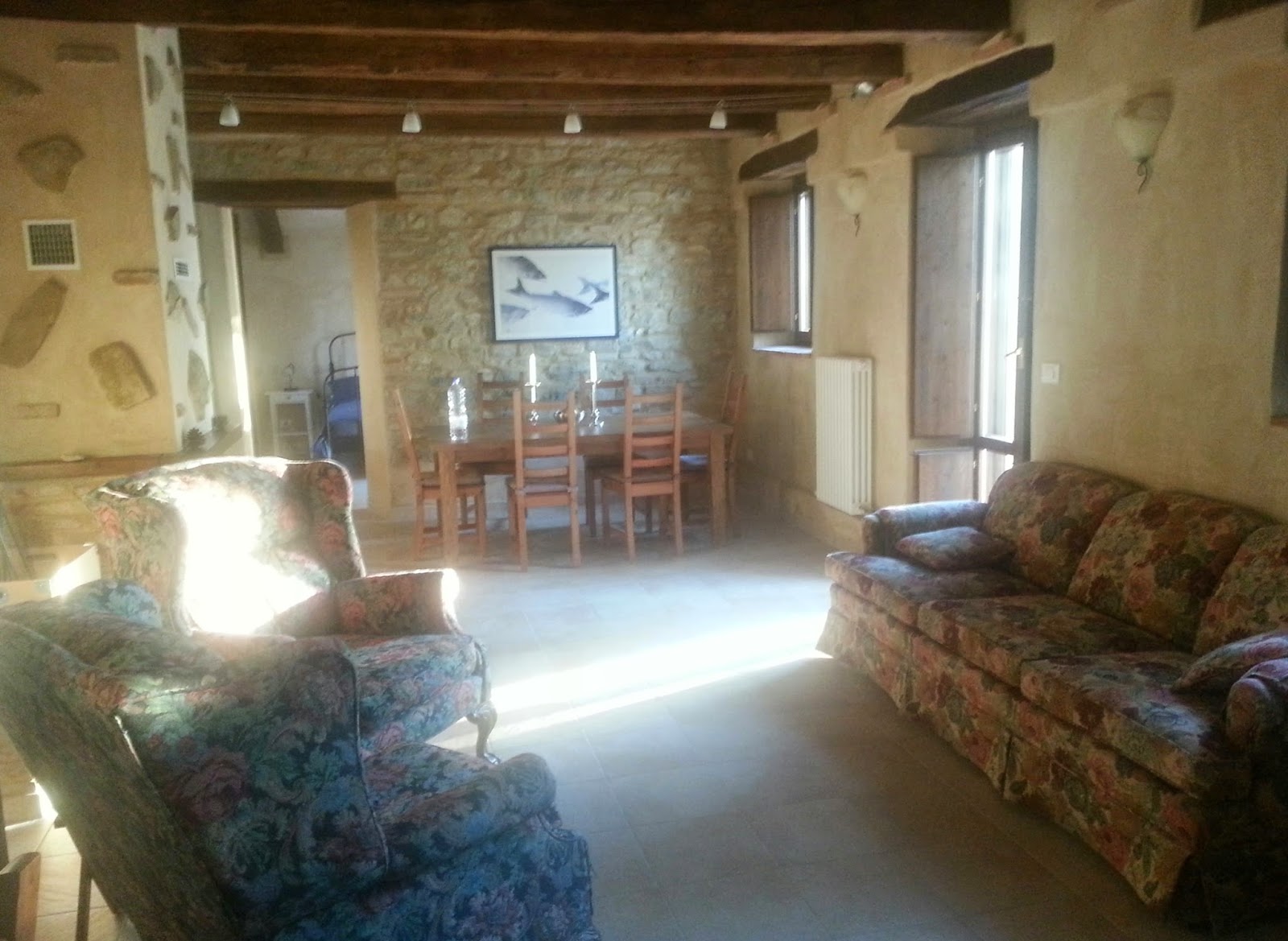
The living room in the downstairs unit of LUliveto Staffolano.

From L’Uliveto Staffolano  Mark and Margaret’s beautifully appointed Italian home, which is a very short drive from Staffolo and most of the year is available for long-term, self-catering rental  the views in every direction are simply breathtaking. Twice-weekly market days provide all kinds of local produce and products. Local festivals of music and dance, accompanied by delicious food offerings, occur frequently, at least in summer.

Ready to dine on the rear patio at LUliveto Staffolano.

For a break from home cooking and festival food, we visited Staffolo’s Grotto di Frate, a fine restaurant in the city’s ancient wall, for wonderful pizza and local dishes. Many other nearby towns have their own festivals and attractions. We visited Ancona’s sea coast, Gubbio’s historic ducal palace and Roman amphitheater, and the relatively recently discovered caverns of Frasassi. Of course, the best part of any community is its people, and I’m blessed now to have many new friends from among the welcoming people of Staffolo. I would return in a heartbeat. Ciao, amici!

The view from the patio outside my room at LUliveto Staffolano.

Thanks
Unquestionably, this was a trip of a lifetime for me. I simply cannot fully express my gratitude to all who made this possible, nor can I possibly list everyone who deserves credit. But, I must name a few.

Mark Lindenbaum, who got this all to happen. Thanks, Mark.

First, my deepest gratitude to Mark Lindenbaum for many years of good friendship and collaboration and the warm hospitality I have always received from him and Margaret. Adding the Amici Americani to the Staffolo Band’s music festival was Mark’s idea, and it was he who brought me on board to play, conduct, and have my music featured at the festival. I also thank the rest of the Amici  Tom Hyde, Tyler Morse, and John Monroe – for their friendship and musicianship over many years and in Staffolo.

Many people worked long hours on the Italian side of things to make this year’s festival the great success that it was. Staffolo Band President Simona Bastari met me at the Jesi train station and deserves much credit. Accompanying her was band Secretary Damiano Cerioni, who is clearly a mover and shaker. He gets things done! And the band is full of hardworking planners and doers, including Vice President Patrizio Bianchi, Second Vice President Massimiliano Scortichini, Stefano Aquilanti, Italo Meschini, Matthia Zepponi, Sofia Sassaroli, Guido Mercanti, and others. The Staffolo City Band’s conductor, Maestro Samuele Faini, was a most gracious and helpful host. Staffolo Mayor Patrizia Rosini’s support was clearly essential. Thank you, Patrizia.

Ray and Mirko Donninelli. Gracie, Mirko!

And I could hardly have functioned as a conductor without the able assistance of young hornist Mirko Donninelli, who translated for me with enthusiasm and excellence and who enabled me by week’s end to conduct a rehearsal in Italian, more or less.

More of Italy
Having not visited Italy before, I extended my trip to include research visits to Milan, Varenna, Florence, Rome, and Venice. Traveling on my own, I visited many museums and churches. Images of trumpets and trumpeters may often be found in art from the Renaissance forward, and there is no better place on earth to study the Renaissance than in Italy.

My composition, Italian Postcards for brass quintet (or septet), was composed many years ago, long before I ever set foot on Italian soil. With a trip planned to Italy, it was natural for me to visit the three cities which figure prominently in Italian Postcards: Rome, Venice, and Milan. I am happy to report that all three cities sound just exactly like I composed them! The following are a few of my trip photos.

Brass instruments at Sforza Castle.

Nabucco costumes in the Teatro alla Scala Museum.

Milans famed Galleria Vittorio Emanuele II.

Beautiful Varenna on Lake Como.

The Galleria dellAccademia in Florence has a few brass instruments,
in addition to Michelangelos great David.

I finally experience Roma. Sunrise at the Colosseum.

Rehearsing the Staffolo City Band. Good times!

The horns.


The trombones.

The trumpets.

The tubas, Number One!


The saxes.

Italo, anchor of the percussion section.

The church acoustics were perfect for a little unaccompanied trumpet.

The Amici cross a road on the way to the concert.

Amici at the great gate of Staffolo.

Amici sound check in the piazza.

Matthia Zepponi, the Staffolo bands excellent first trumpeter, plays a solo.


Staffolo City Band Maestro Samuele Faini and event planner Damiano Cerioni.

Band president Simona Bastari, Mark Lindenbaum (whose idea this all was),
and the man who gets things done, Damiano Cerioni.

My favorite photo of all: Staffolos band and audience on a beautiful night,
in the historic piazza, enjoying a concert of music among friends, new and old.

Inside St. Mark’s basilica in Venice. This is where the antiphonal music of Andrea
and Giovanni Gabrieli was first performed. You can see the walkways atop the
first-floor arches that ancient musicians used to access positions in the balconies.

CODA
In a sense, an experience like this never really ends. I will ponder and reflect on the things I saw and the people I met for many years to come. New friendships will continue. New blooms may grow on this plant which began years ago as a seed in the thought of Mark Lindenbaum. New music is forthcoming that may delight and endure. And so on. I am not the same man who boarded a jet in June to travel to Italy for the first time. I am enriched and blessed. Even the world, if only a little, is a changed and better place.

This blog post, however, must end. I hope my amici, both Americani and Staffolani, will feel free to respond below and keep in touch.

Arrivederci!