Monday, July 21, 2014

I’m In Italy!

Actually, I’m back home now, but I was in Italy for most of June and the early part of July 2014, and it was great. This is that story.


Why
I went to Italy this summer to participate in the 20th Annual Music Festival offered by the Banda Musicale Città di Staffolo (Staffolo City Band). The festival concerts were given in Staffolo’s ancient piazza on June 28 and 29. For two videos from one of our concerts, and videos from other parts of the festival, go HERE.

My friends, Mark Lindenbaum and Margaret Jahn of Bellingham, Washington, recently renovated a farm house [see L’Uliveto Staffolano] near Staffolo that is available to rent for self-catering vacations and which they visit once or twice per year. Given tubist Mark’s love for brass chamber music and his enjoyment of Staffolo, it was only a matter of time before he invited fellow brass players to Staffolo to play chamber music.

L'Uliveto Staffolano: self-catering apartments just outside Staffolo, Italy.

But, Mark had larger plans. In recent years he has made friends in the Staffolo City Band. Working with civic and band leaders, a plan was formed to enlarge Staffolo’s annual band music festival to include brass chamber music played by a brass quintet assembled by Mark for the occasion.

Thus, the Amici Americani degli Ottone (American Friends of Brass) came to be. A large brass and percussion ensemble comprised of Amici and Staffolo band brass players was organized. The Amici Americani also performed in concerto grosso fashion with the Staffolo band, and the Staffolo band performed one of my compositions. The Amici and the large brass ensemble also performed some of my works.

Rehearsing the large combined brass ensemble.

Other musical and civic events were scheduled for the festival weekend, including a concert by the Orchestra di Fiati (Wind Orchestra) della Provincia di Vicenza with their featured soloist, Italian tuba virtuoso Alessandro Fossi. The Amici Americani joined Fossi to perform the Concertino da camera for solo tuba and brass quintet by Swedish composer Christer Danielsson (1942-1989).

The Amici Americani with tuba soloist Alessandro Fossi.

Festival performances were also given by the Banda di Torrette e di Ostra and the Orchestra di Fiati del Liceo Rosmini di Rovereto.


It was a pleasure and an honor to rehearse and perform with the Amici Americani and Alessandro Fossi and to conduct the large brass ensemble and the Staffolo band.


Where
Staffolo is a small town about thirty minutes west of the Adriatic port city of Ancona in the eastern central region of Italy known as Le Marche. [Wikipedia] [Images] Staffolo is considered one of the Best Small Towns in Italy. This video shows many images of the town where I spent one of the best weeks in my life. If you haven’t visited there, I highly recommend it!

One of the entrances to the walled city center of Staffolo.

Staffolo’s new Mayor, Patrizia Rosini, welcomed the Amici and the guest bands warmly and enthusiastically. She also presided over a formal ceremony recognizing the various participants in the music festival, where she presented me with a book containing important historical Staffolo documents, for which I am most grateful. Patrizia used to play tenor saxophone, so I think the Staffolo City Band has a bright future!

Ray and Staffolo Mayor Patrizia Rosini.

Who
Amici Americani degli Ottone 

Amici Americani di Ottone in Gubbio, Italy (L to R):
John Monroe, Ray Burkhart, Tyler Morse, Mark Lindenbaum, and Tom Hyde.

Mark Lindenbaum formed the Amici Americani degli Ottone (American Friends of Brass) from friends made at the Humboldt State University Brass Chamber Music Workshop. The players include trumpeters Tom Hyde of Graton, California and me; hornist Tyler Morse of Brisbane, California; trombonist John Monroe of Stanford, California; and Mark on tuba.

Amici Americani in concert in Staffolo’s piazza, June 28, 2014.

We spent a wonderful week in Staffolo preparing for the two concerts, but one cannot play a brass instrument all day, so the Amici visited nearby sights. At a local Staffolo festival, we heard local musicians, saw costumed children present regional dances, tasted local seafood and olive specialties, and met our first new Staffolo friends. Ciao, Anno! The nearby town of Cupramontana and its morning market supplied tasty cheeses, meats, and vegetables. Half-day trips to the Frasassi caves and the ancient hill town of Gubbio, with its Roman amphitheater, provided geographical and cultural delights. I introduced Tom to granite – Italy's yummy fruit slushes – and we all sought to find the best gelato.

Tom Hyde and I cool it in Cupramontana.

The Staffolo City Band


The Banda Musicale Città di Staffolo in a proper pose.

The Staffolo City Band is made up of talented and fun musicians from the Staffolo area and nearby towns. Community bands figure importantly in Italian culture, and the Staffolo City Band appears in concerts and parades in Staffolo and surrounding communities and also travels to perform. Players in the band range from boys and girls in grade school to retired folks, with everything in between! Daily rehearsals with the Staffolo band and its brass players were a highlight of the week. 

Some of the band, as I came to know them. They’re not as blurry in real life.

The Music
The Saturday night concert began with the large brass and percussion ensemble, followed by the Amici Americani brass quintet’s program and the band’s two pieces. Here’s the program (all of my compositions are in print and available for purchase--see links below):

Combined Brass and Percussion
Raymond Burkhart, Conductor

Aaron Copland, Fanfare for the Common Man
Chris Hazell, Kraken 
Hazell, Mr. Jums
Jimmy McHugh (arr. John Iveson), On the Sunny Side of the Street
Raymond Burkhart, Rejoice!

(Kraken was encored.)

Amici Americani degli Ottone
Victor Ewald, Brass Quintet No. 1
Luigi Zaninelli, Designs
Kevin McKee, Escape
John Cheetham, Scherzo

Staffolo City Band
Raymond Burkhart, Conductor

Rayburn Wright, Shaker Suite for Brass Quintet and Band
Samuele Faini, Conductor

(Sophie’s Waltz was encored.)

The Sunday night concert featured a daring and highly polished program by the Orchestra di Fiati (Wind Orchestra) della Provincia di Vicenza. In addition, the Concertino da Camera for solo tuba and brass quintet by Swedish composer Christer Danielsson was performed by Alessandro Fossi and the Amici Americani.

Looking Forward: A New Commission
In relation to my appearance at the 2014 Staffolo Music Festival, Mark Lindenbaum, Margaret Jahn, and John and Meg Monroe have commissioned me to compose a new work for brass quintet based on my experiences in Italy. It is to be a three-movement suite of approximately ten minutes in length, due by summer 2015. I have already begun work. [In late 2014 I complete Ricordi d'Italia, a four-movement suite for brass quintet, based on this trip-adventure.]

The Accommodations
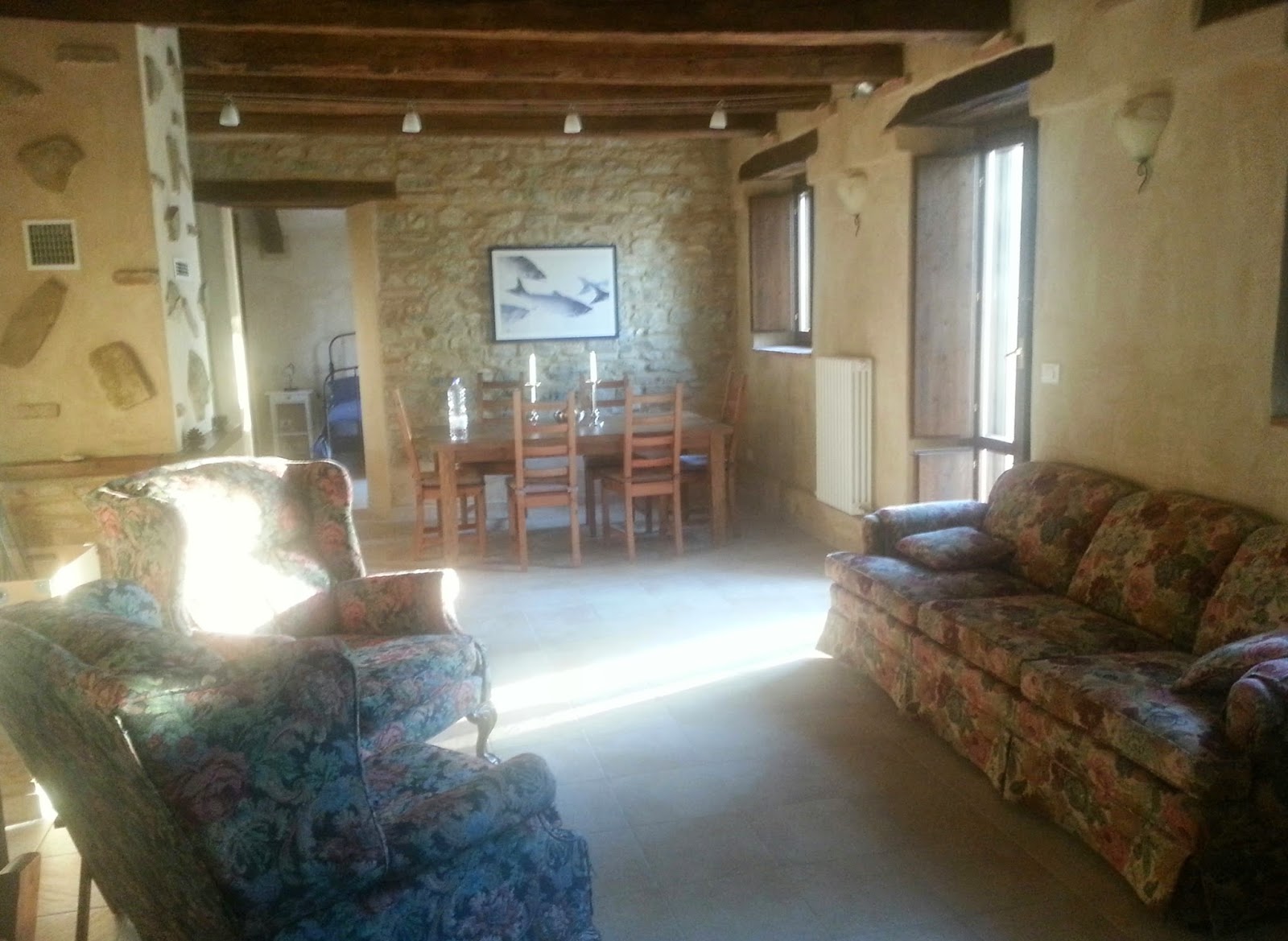
The living room in the downstairs unit of L’Uliveto Staffolano.

From L’Uliveto Staffolano – Mark and Margaret’s beautifully appointed Italian home, which is a very short drive from Staffolo and most of the year is available for long-term, self-catering rental – the views in every direction are simply breathtaking. Twice-weekly market days provide all kinds of local produce and products. Local festivals of music and dance, accompanied by delicious food offerings, occur frequently, at least in summer.

Ready to dine on the rear patio at L’Uliveto Staffolano.

For a break from home cooking and festival food, we visited Staffolo’s Grotto di Frate, a fine restaurant in the city’s ancient wall, for wonderful pizza and local dishes. Many other nearby towns have their own festivals and attractions. We visited Ancona’s sea coast, Gubbio’s historic ducal palace and Roman amphitheater, and the relatively recently discovered caverns of Frasassi. Of course, the best part of any community is its people, and I’m blessed now to have many new friends from among the welcoming people of Staffolo. I would return in a heartbeat. Ciao, amici!

The view from the patio outside my room at L’Uliveto Staffolano.

Thanks
Unquestionably, this was a trip of a lifetime for me. I simply cannot fully express my gratitude to all who made this possible, nor can I possibly list everyone who deserves credit. But, I must name a few.

Mark Lindenbaum, who got this all to happen. Thanks, Mark.

First, my deepest gratitude to Mark Lindenbaum for many years of good friendship and collaboration and the warm hospitality I have always received from him and Margaret. Adding the Amici Americani to the Staffolo Band’s music festival was Mark’s idea, and it was he who brought me on board to play, conduct, and have my music featured at the festival. I also thank the rest of the Amici – Tom Hyde, Tyler Morse, and John Monroe – for their friendship and musicianship over many years and in Staffolo.

Many people worked long hours on the Italian side of things to make this year’s festival the great success that it was. Staffolo Band President Simona Bastari met me at the Jesi train station and deserves much credit. Accompanying her was band Secretary Damiano Cerioni, who is clearly a mover and shaker. He gets things done! And the band is full of hardworking planners and doers, including Vice President Patrizio Bianchi, Second Vice President Massimiliano Scortichini, Stefano Aquilanti, Italo Meschini, Matthia Zepponi, Sofia Sassaroli, Guido Mercanti, and others. The Staffolo City Band’s conductor, Maestro Samuele Faini, was a most gracious and helpful host. Staffolo Mayor Patrizia Rosini’s support was clearly essential. Thank you, Patrizia.

Ray and Mirko Donninelli. Gracie, Mirko!

And I could hardly have functioned as a conductor without the able assistance of young hornist Mirko Donninelli, who translated for me with enthusiasm and excellence and who enabled me by week’s end to conduct a rehearsal in Italian, more or less.

More of Italy
Having not visited Italy before, I extended my trip to include research visits to Milan, Varenna, Florence, Rome, and Venice. Traveling on my own, I visited many museums and churches. Images of trumpets and trumpeters may often be found in art from the Renaissance forward, and there is no better place on earth to study the Renaissance than in Italy.

My composition, Italian Postcards for brass quintet (or septet), was composed many years ago, long before I ever set foot on Italian soil. With a trip planned to Italy, it was natural for me to visit the three cities which figure prominently in Italian Postcards: Rome, Venice, and Milan. I am happy to report that all three cities sound just exactly like I composed them! The following are a few of my trip photos.

Brass instruments at Sforza Castle.

Nabucco costumes in the Teatro alla Scala Museum.

Milan’s famed Galleria Vittorio Emanuele II.

Beautiful Varenna on Lake Como.

The Galleria dell’Accademia in Florence has a few brass instruments,
in addition to Michelangelo’s great David.

I finally experience “Roma. Sunrise at the Colosseum.”

Rehearsing the Staffolo City Band. Good times!

The horns.


The trombones.

The trumpets.

The tubas, Number One!


The saxes.

Italo, anchor of the percussion section.

The church acoustics were perfect for a little unaccompanied trumpet.

The Amici cross a road on the way to the concert.

Amici at the great gate of Staffolo.

Amici sound check in the piazza.

Matthia Zepponi, the Staffolo band’s excellent first trumpeter, plays a solo.


Staffolo City Band Maestro Samuele Faini and event planner Damiano Cerioni.

Band president Simona Bastari, Mark Lindenbaum (whose idea this all was),
and the man who gets things done, Damiano Cerioni.

My favorite photo of all: Staffolo’s band and audience on a beautiful night,
in the historic piazza, enjoying a concert of music among friends, new and old.

Inside St. Mark’s basilica in Venice. This is where the antiphonal music of Andrea
and Giovanni Gabrieli was first performed. You can see the walkways atop the
first-floor arches that ancient musicians used to access positions in the balconies.

CODA
In a sense, an experience like this never really ends. I will ponder and reflect on the things I saw and the people I met for many years to come. New friendships will continue. New blooms may grow on this plant which began years ago as a seed in the thought of Mark Lindenbaum. New music is forthcoming that may delight and endure. And so on. I am not the same man who boarded a jet in June to travel to Italy for the first time. I am enriched and blessed. Even the world, if only a little, is a changed and better place.

This blog post, however, must end. I hope my amici, both Americani and Staffolani, will feel free to respond below and keep in touch.

Arrivederci!

Thursday, April 24, 2014

"Five Sea Shanties" Kickstarter Project Successful

Ahoy! Run up a victory flag!! My "Five Sea Shanties" Kickstarter project was a success. This is the Captain's Log for that campaign. Scroll down for the list of generous supporters!

The Music
In late 2013, I wrote some sea shanty music for the Premiere Brass Quintet to perform at the Edendale Branch of Los Angeles Public Library as part of a month-long citywide focus on Herman Melville's novel, Moby Dick. Even after the concert, I just couldn't stop adapting traditional sea shanty tunes into classical chamber music works for brass quintet. One shanty led to another until I had a set of five. The original shanty tunes upon which my works are based are The Maid of Amsterdam, Goodbye My Love Goodbye, Clear the Track and Let the Bulgine Run, Shenandoah, and Blow the Man Down. [These shanties are now published by Premiere Press for brass quintet under the title, Five Sea Shanties.]

Context
Only after my work was mostly finished did I learn that the British composer Malcolm Arnold (1921-2008) composed his youthful Three Shanties for Wind Quintet (Op. 4) exactly sixty years before. It's nice to be in such company, especially since Arnold was a trumpet player, too. Perhaps I'll adapt my five shanties for woodwind quintet someday. Arnold's three movements are based on What Should We Do With A Drunken Sailor, Boney Was A Warrior, and Johnny Come Down to Hilo.

An Unusual Idea
Knowing my five shanties would make a great publication, I cast about with friends to find if someone might want to commission the music after the fact. It was an unusual idea, but I was sure someone would have commissioned the music, if only they had thought of it. Then in 2014, not yet having found a commissioning party, it occurred to me to bring Five Sea Shanties to publication as a Kickstarter project. [My Five Sea Shanties Kickstarter page] 

Commissioning music is great thing to do, with a long, important, and glorious history. If YOU want to commission a composition from me, I would love to hear from you. Please write: ray@raymondburkhart.com.

The KS Project
I developed the project over a couple of weeks in early March and launched on March 13, with an end date of April 7. Almost immediately, I was contacted by Althea Kifer, a long-time family friend, who wanted to commission the piece. Other pledges ranged from $5 to more than 100 times that amount. Most, but not all, of the supporters are acquaintances of mine. At the KS deadline, the goal had been well surpassed, especially since some supporters preferred not to put charge card info online (something I had not anticipated) and snail-mailed me their support instead. 

Additional support is still coming in. If you want to support the project at this time, please visit my Kickstarter page to read about the project, then contact me privately (ray@raymondburkhart.com).

To find out even more about the Kickstarter project, I recommend you visit my Five Sea Shanties KS page and my introductory blog on the project. You'll find many more details, sound clips, a brief video by me, and even samples from the score and parts.  

The Commissioning Party
Althea Kifer, who commissioned the music, and my mother were both raised in Eagle Rock, a district of the City of Los Angeles. They attended the same schools, but were not in the same class, and they eventually cemented a lifelong friendship as fellow students at UCLA. Their friendship continued, even flourished, after each married and as their teaching careers progressed. Althea and her husband Jack had business to attend to each year near the small Northern California town of Red Bluff, where my family lived after 1968, and annual visits from the Kifers were highly anticipated in our family. I have many fond memories of their visits. Jack and Althea were also world travelers; Althea still is. They never failed to send our family a postcard every summer from some faraway locale, and these communiques helped to stir my interest in the world and travel. In time, I became a stamp collector, and the postcards took on even greater meaning. When I composed Italian Postcards, the title and concept of the piece arose out of these memories, as if the piece were based on three picture postcards from three popular Italian tourist destinations. [See blog.] I dedicated Italian Postcards to Jack and Althea. And now, I thank Althea deeply for commissioning Five Sea Shanties, which I think will become as popular as Italian Postcards.

The Dedication
I have dedicated Five Sea Shanties to my friend, David Newbern, who is a long time legal eagle in the state of Arkansas (including former Justice of the Supreme Court of Arkansas); a strong proponent of folk music and an outstanding folk musician and recording artist (voice, mandolin, guitar, and banjo); and an avid and able amateur tuba player. It is through his tuba playing that we met and became friends at the Humboldt State University Brass Chamber Music Workshop many years ago, and for his friendship I am most grateful. If you know David, if you have any interest at all in folk music, or if you're just have an inquisitive nature, I recommend you read Brooks Blevins' interview of David as part of the oral history project on the creation and development of the Arkansas Folk Festival and Ozark Folk Center.

Gratitude
I am deeply grateful to every one of this project's supporters for their generosity. Since each bit of support represents a kindness that is unquantifiable in dollars, I have listed the supporters alphabetically. If your name has been left off or requires correction in any way, please let me know. And if your support arrives after this blog is published, I can easily add you to it!

I offer my sincerest thanks to these kind supporters:

Richard Ashmore, Douglas R. Barnett, Philip Beard, Wayne Bennett, William Bing, Diane and Bob Boisvert, Heather Frederick Brown, Bill Bunyan, Patti Brugman, Noel Collins, Robin Collins, David Cornell, Chris Cox, Annette Dutenhoffer, Chelsea Dutenhoffer, Terry Farmer, Harry Fix, Gregory Franklin, Dale Frazier, Noah Gladstone, Frederick Greene, Honor and Walter Haase, Randall Jones, Althea King Kifer, Stephen Klein, John Klinedinst, Karolyn Labes, Audrey Lamprey, Geoff and Lisa Marshall, Jim McGlynn, John Monroe, Suzette Moriarty, Kristin Morrison, Tyler Morse, David Nicholson, Anthony Noble, Annabelle Nye, Stephanie O'Keefe, Emilie Pallos, Jay Perry, Clint Phillips, Chris Popperwell, Richard L. Rapp, Ridgecrest Brass Ensemble, Jayne Sawyer, Chuck Schroeder, Grace Sheldon-Williams, Kathy Silbiger, Harry Smallenburg, Lynne Snyder, Robb Stewart, Nancy Stone, Larry Tallant, Brian Taylor, John R Taylor, Fred Tempas, Jim Tidwell, Gary Tirey, the Thiel Family, Carolyn Tiernan, Jim Walker, John J. Walsh IV, the Wiegand family, Sheila M. Upham, and Adriana Zoppo.

Thank you all.
Ray

Thursday, March 13, 2014

"Five Sea Shanties" for Brass Quintet – Please Support My New Kickstarter Project

I've created a Kickstarter project to help launch my newest piece of music – "Five Sea Shanties" for brass quintet – into publication! If you're not familiar with Kickstarter, it's like having a PBS pledge drive. There are varying levels of support, and each successive level brings donors additional rewards. The deadline to reach my pledge goal is April 7, around 1pm Pacific time. To read about the music, find the rewards, see an introductory video by moi, and make a pledge, go here: https://www.kickstarter.com/projects/1815997771/five-sea-shanties-for-brass-quintet
And please spread the word to your friends!

One of the rewards is a refrigerator magnet with the above design.
Other rewards include autographed copies of the music, a meeting with me,
the honor of commissioning the music, receiving the dedication, and more!

One of the project rewards was to commission the music. That reward has been claimed! I'm also seeking someone to receive the dedication. Yes, you can pledge to receive the right to designate to whom "Five Sea Shanties" is dedicated. The dedication appears next to the title of the music on both score and parts. It could read, "For Insert Your Name Here," or you could have it say, "Dedicated to the So-And-So Family," or you could nominate your parents, or kids, or a even a pet. I once dedicated a piece to a horse, so you would not be the first in that regard! You could even memorialize someone – "In memoriam Dearly Beloved." It's up to you. [Go to project]

There are several other rewards, too, including receiving an autographed copy of the sheet music and getting a private meeting with me. Most of the rewards include all the previous rewards in the ascending levels of pledging. Many donors will receive a handsome "Five Sea Shanties" refrigerator magnet and a personal thank-you note from me. All donors will be recognized in my blog.

Just a few more details here. The five sea shanties are "The Maid of Amsterdam," "Goodbye, My Love, Goodbye," "Clear the Track and Let the Bulgine Run," "Shenandoah," and "Blow the Man Down." I've included descriptions of the music (and sound clips) at the Kickstarter page. Go there to hear most of each movement and find out what the word "bulgine" means! [Go to project]

Lastly, please spread the word. Tell your friends, and ask them to tell their friends! There are lots of people who will love this project, want to support it, and who will enjoy the rewards. But, they have to learn of it first. Be the one to let them know, by social media, email, text, IM, blog, phone, fax, semaphore, smoke signals, or even in person – if anyone communicates that way anymore. It's all good. And remember, a great many arts donors are not musicians! So, be sure to share this with your musician friends and with committed concert-goers and arts patrons, as well.

Much appreciated,
Dr. Ray

Thursday, February 6, 2014

College of the Canyons Symphonic Band: Spring 2014!

It's time once again to enroll for the wonderful Symphonic Band at College of the Canyons. I'll use this blog entry as a resource for the band for this semester, so check back for new information added at the bottom. We also have a College of the Canyons Symphonic Band Facebook page you can read and follow.

Our theme for Spring is "Around the World in 80 Minutes: A Celebration of International Band Music." We'll also continue our fruitful relationship with composer/tubist William Roper, our Artist-in-Residence for 2013-2014.

Dr. Ray Burkhart conducts the COC Symphonic Band, Dec. 2, 2013

The Spring term begins on February 10, 2014, and since that is a Monday, it's also the first class meeting/rehearsal. 6pm to 10pm on Monday nights, except for holidays. Generally, the woodwind/harmonie ensemble meets from 6-7pm, the full band from 7-9pm, and the brass ensemble from 9-10pm.

College of the Canyons, a part of the California Community College system, is located in Santa Clarita (Valencia), just north of CalArts, a short distance north of the intersection of Interstate 5 and Highway 14. The Music Building – Pico Canyon Hall – is fairly new and is well suited for band rehearsals. We meet in room 202 (PCOH 202). Our May 19 concert will once again be given in the wonderful acoustic of the lobby of the COC University Center.

Dr. Ray gives interesting program notes to the audience!

Given COC's proximity to Los Angeles and Hollywood, a great many world-class musicians live nearby and are friends of mine. COC Symphonic Band members have already enjoyed visits from, and have performed along side, outstanding  concert and recording musicians and composers. I also encourage students who are well prepared to solo with the band to audition to solo. Student composers, too, who play in the band might be able to have their works performed. The COC Symphonic Band experience is a rich one.

If you have any questions, please enter them below, or email me at ray@raymondburkhart.com. Thanks.

Dr. Ray

Friday, January 10, 2014

"Watercolor Menagerie" – Its First Decade, Part One: Gratitude

I remember it like it was yesterday. Ten years ago – almost to the day – I awoke one morning and my first thought was, "I need to make a CD." Five months later, boxes of "Watercolor Menagerie" CDs arrived on my doorstep.

Now – ten years after the release of "Watercolor Menagerie" – it is still widely enjoyed, still sells, and the compositions on the recording are still played by brass quintets in the US and internationally. Increasingly so. I have seen this music  move audiences to laughter and other audiences to tears. Douglas Wilson wrote of "Watercolor Menagerie" in the Journal of the International Trumpet Guild, "The music is well crafted, programmatic, and contemporary and has a flavor of Hollywood. Of note is Burkhart's fine work on the piccolo trumpet." It's time to celebrate the CD's ten-year record of success: first, with gratitude.

But, before I go further, yes, you too can get "Watercolor Menagerie" at my website and from iTunes and CD Baby. I'm sure you'll like it!


First, I thank all of you who purchased the music on CD and online, especially the many of you who have sent notes telling me what the music means to you. The compositions and the CD were labors of love, and your kind notes always touch me deeply. You can easily reach me at ray@raymondburkhart.com.

Second, many thanks to the many brass quintets that continue to program the pieces on this CD (and my many newer compositions and arrangements for brass quintet that are not yet recorded). I now have enough new works for a second CD, and the commissions continue to come. The business world has its "angels," and the modern music world would greatly benefit from a similar practice. In the arts, it's actually an ancient tradition called patronage. If you're a fan-"angel," or want to be, don't remain a stranger!

Third, I offer my deep gratitude to the marvelous musicians who played on the recording: trumpeter Kevin Brown, hornist Steve Durnin, trombonist Loren Marsteller, and tubists Norm Pearson and Fred Greene. (More about the two tubists later.) Your talents enhanced "Watercolor Menagerie" greatly.

Many who play music or sports, or participate in group projects, know how fulfilling it is to work (or play) with great masters. When those great masters are dear friends, it's even more special. My colleagues on this recording are indeed both musical masters and dear friends. All have for many years been highly sought-after musicians in the competitive and world-class freelance market that defines Southern California concert halls and the "Hollywood" recording studios. You don't need to know about that to enjoy the CD – the music speaks for itself – but, the more you know about brass playing, the more you will appreciate what these wonderful musicians achieved on this recording.

The Premiere Brass Quintet, recording "Watercolor Menagerie": (L-R)
Raymond Burkhart, Loren Marsteller, Norm Pearson, Steve Durnin, Kevin Brown.

If you have the chance to make music with a great musician for most of your life, do it. I have. I first met Kevin Brown at Claude Gordon's first summer music camp. I was still in high school, and Kevin had just graduated. After college, we met again and started working together in Los Angeles. His playing and good nature are as easygoing as it gets, and nearly every major professional ensemble in the Los Angeles area has been blessed by his great musicianship and good cheer, from the Los Angeles Philharmonic Orchestra right on down the list. We have collaborated countless times. Lots of music, lots of laughs.

Steve Durnin has a significant career in the recording studios and orchestras of Los Angeles and Hollywood. In my early days freelancing, some players just stood out as wonderful people, in addition to being wonderful players. That's Steve. He plays the horn effortlessly, with a sharpshooter's accuracy, and he shifts into a variety of non-classical styles on a dime. He can also move a refrigerator with aplomb. (That's not on any audition lists, but it does quickly cement a friendship.) He is also extraordinarily knowledgeable on seemingly endless topics (I think he has a photographic memory), and I learned to fly-fish under his patient tutelage.

I also first met Loren Marsteller long ago, when he was preparing to be a guest soloist with the Caltech Concert band, conducted by my teacher, the great trumpeter and pedagogue, William Bing. As we were introduced, Bill said in almost hushed tones, "Loren was euphonium soloist with the President's Own Marine Band." I was in awe of that then, and I still am! But, Loren's really a jolly, cherub-like, fun-loving Santa lookalike, with a sincere humility rarely found in someone with a world-class reputation. I've learned a lot about music from working with him.

Norm Pearson, of course, has been the tubist with the Los Angeles Philharmonic Orchestra for decades! In fact, Norm and I were housemates when he won that job, and I recall listening to him practice his excerpts for hours and hours. And hours. Day and night. He, too, is just as nice a guy as you'll ever find. We freelanced together many times in brass quintets and brass ensembles in those early days, when we were students together at the University of Southern California.

But, as long as I've known all those guys, it's Fred Greene that I've known the longest. I first met Fred when we both attended Lincoln Street Elementary School in Red Bluff, California. Fred was one year ahead of me, and he played trumpet. I recall knowing even then that he was a good musician. Later, we played in the Bidwell Middle School band as he transitioned to baritone, and by the time I got to Red Bluff Union High School, Fred was playing sousaphone, because the band had no tuba. After he earned a spot in California's All State Honor Band in only his sophomore year, the school quickly found the funds for a real tuba, and the investment was one of the best they ever made. Fred has always played with an unusually high musical authority and sensibility. He would have been a great master on any instrument, such is his innate musicianship.

You may ask, Why are there two tubists on my CD? Simple. Our recording location was only available for a few days, and we couldn't accommodate everyone's schedule. Norm had conflicts with the LA Phil, and Fred had conflicts with recording dates. So, I used them both. What an embarrassment of riches!

You can read my "New Year's Guide to Watercolor Menagerie" and A Brief History of the Premiere Brass Quintet elsewhere in this blog. I expect soon to write Part Two of this "Watercolor Menagerie" retrospective: "The Music." In the meantime, give "Watercolor Menagerie" a fresh hearing or a first hearing. You'll be glad you did.

Monday, October 7, 2013

William Roper and the College of the Canyons Symphonic Band

William Roper, a multidisciplinary artist based in Los Angeles, will be Artist-in-Residence for the College of the Canyons Symphonic Band for the academic year 2013-2014. Roper is active in the fields of composition, music performance (especially on tuba), theater, dance, painting, and performance art. He will compose new works for tuba and winds to be performed by the COC Symphonic Band.

William Roper in Bavaria

On tuba, Roper's professional experience ranges from the symphony stage to free improvisation groups. He has toured North and South America and Europe as a soloist and as a member of jazz, rock, and classical ensembles. His has released several recordings as a leader and co-leader. He has played or recorded with numerous artists and ensembles, including the Los Angeles Philharmonic Orchestra, Elton John, Leon Russell, Jusef Lateef, James Newton, and Horace Tapscott. He has also played on several major motion picture soundtracks.

As a composer he has fulfilled commissions for the Gloria Newman Dance Theater, Dance L.A., and SASSAS. His compositions have been performed in the US and Europe. He has received awards from organizations such as the National Endowment of the Arts, California Arts Council, City of Los Angeles Department of Cultural Affairs, Meet the Composer, American Music Center, American Composers Forum, Durfee Foundation, Brody Arts Fund, and others. He has been a resident composer at the Djerassi Institute in California and the Oberfaelzer Kuenstlerhaus in Bavaria and recently fulfilled a cultural ambassadorship to Japan.

I have blogged about Roper before, because I find him to be an unusually interesting person and musician. You can read that blog here. Visit Roper's Web site here.

It is an important part of my plan to grow the COC Symphonic Band and its audience to invite eminent musicians like Roper to visit COC and work with the music students. A great deal can be learned from great musicians, and the greater Santa Clarita Valley area (including its many neighbors to the south) has many great musicians in its midst. The music world is smaller that it seems, and Roper's visits with the COC Symphonic Band will provide opportunities for much more than learning. Lifelong relationships sometimes come of such experiences.

Concerts by the COC Symphonic Band which will feature Roper and his works will be given on Monday, December 2, 2013 and Monday, May 19, 2014 in COC's Van Hook University Center. Both concerts begin at 8pm and are free to the public. Our December concert will feature "Four Centuries of Music for Band," while the May concert will take a more geographical look at band music in "Around the World in 80 Minutes."

Dr. Ray

Thursday, September 5, 2013

Melville, Moby, and Music: A Concert by the Premiere Brass Quintet

I've read Herman Melville's classic novel, Moby Dick. There's not a brass quintet in it anywhere.

But that minor detail will not daunt the Premiere Brass Quintet and I from embarking on a musical exploration of Moby Dick, Melville's life and times, his influences, and the results of his influence in a free community concert entitled, "Melville, Moby, and Music," to be given Noon to 1 p.m., Saturday, September 7, 2013 at the Edendale Branch Library in Echo Park (2011 W. Sunset Blvd., Los Angeles, CA 90025). Come hear us in the Community Room. There will be free parking in the library lot.


Actually, the elusive white whale will be making appearances all over Los Angeles in September as part of the "Whatever Happened to Moby Dick" celebration sponsored by the Los Angeles Public Library and the Library Foundation of Los Angeles.


For our part, our concert program provides musical answers a few questions.

What was music like aboard ship in the days of sail?
  • We'll play some sea shanties that I arranged especially for this concert.
Who was one of Melville's principal influences?
  • The art of the British painter, JMW Turner, with its striking imprecision, was a major influence for Melville. We'll play the first movement of my original composition, "Isle of Colours." The work's movements represent and honor three great British painters: JMW Turner, John Constable, and David Hockney.
What was Melville's response to the Civil War?
  • We'll play two recently discovered and newly restored pieces from a collection of original Civil War brass band music. It's as close as you'll get to being there, without going to a reenactment!
How did Moby Dick influence later artists?
  • We'll play two sea-themed pieces of 20th-century art music (arranged for brass quintet by my friend, Charles Warren): the "Jig" from Gustav Holst's "St. Paul's Suite" and Ralph Vaughan Williams' "Sea Songs."
  • We'll also play popular selections from stage and screen that listeners of all ages will enjoy and recall!
  • And we'll close with Ian MacDonald's original composition, the "Maritime Overture" from his "Sea Sketches."
  • (We might even play a new setting of "Shenandoah" as an encore, if needed! It features our tubist, Bill Roper.)
The Premiere Brass Quintet is five professional musicians who are active in the concert halls and recording studios of the greater Los Angeles area: Ray Burkhart and Kevin Brown, trumpets; Steve Durnin, horn; Loren Marsteller, trombone; and William Roper, tuba. We look forward to meeting you and sharing our music with you.

It'll be a whale of a concert, and that's no fluke!

Dr. Ray

[ADDENDUM]

The Premiere Brass Quintet was introduced by Niels Bartels, Senior Librarian of the Edendale Branch of the Los Angeles Public Library, and Library Foundation of Los Angeles President Ken Brecher provided an overview of the month-long, city-wide "Whatever Happened to Moby Dick" celebration and series of events. I announced the selections and provided useful and occasionally humorous historical information and context. The enthusiastic audience gave a hearty standing ovation, and we played my new arrangement of the sea shanty, "Shenandoah," as an encore. Eventually, I wrote five sea shanties (The Maid of Amsterdam; Goodbye, My Love, Goodbye; Clear the Track and Let the Bulgine Run; Shenandoah; and Blow the Man Down) and published them with the astonishingly creative title of Five Sea Shanties.

The Premiere Brass Quintet (L to R): Ray Burkhart, Kevin Brown, William Roper, Steve Durnin, and Loren Marsteller

I thank photographer Vic Pallos and art director Emilie Pallos of Emilie Pallos Graphic Design for the photography.


Read Christina Linhardt's review of the concert HERE.